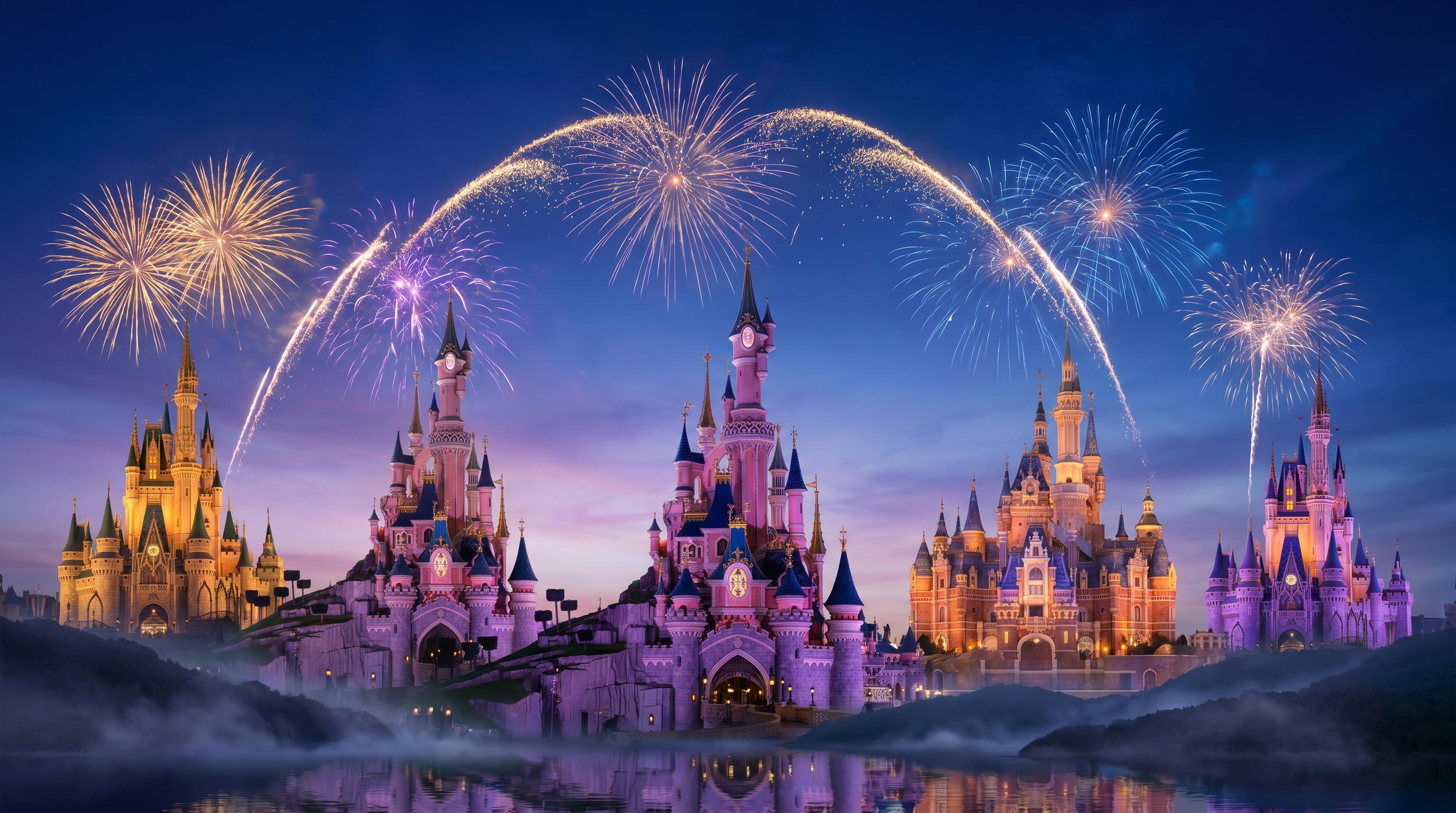

Disney and Universal theme parks are illusion machines designed with a level of detail that scents the obsession. Behind every princess smile, every sweet smell and every castle stone there is engineering, psychology and secrets that most visitors will never discover. We have collected the 20 most fascinating - the ones that really change the way you see these parks - so that in your next visit you will look with other eyes.
1. The smells you breathe are made - literally
If you get into Main Street U.S.A., it's no coincidence. Disney pumpingartificial odorsthrough a patented system calledSmellitzer- a combination of "smell" and "Howitzer" - all over the park. The smell of vanilla and fresh bake from the Main Street bakery does not come from the bakery. It comes from machines hidden on roofs that disperse synthetic fragrances in a controlled way.
The most famous example isSoarin 'in EPCOT, where you smell orange when you fly over California, pine over the forest and sea salt over the ocean. It is not water vapour with aroma: they are odour cartridges programmed to be exactly synchronized with the screen projection. Disney even has patents for odour diffusion systems integrated into the attractions seats.
Also inSpaceship EarthThe scene of ancient Rome is giving away a smell of incense and burning. InPhilharmagicYou smell like apple pie during the scene of La Bella and the Beast. And inThe Tower of Terror(the original version of Hollywood Studios), there is a smell of dust and mold deliberately injected to increase the feeling of abandoned hotel. Nothing is accidental.

2. Disney World underground tunnels (Utilidors)
Under all the Magic Kingdom of Disney World there is a2.8 km tunnel networkcalled "utilidors" - a contraction of "utilidors." It is literally a complete underground level with offices, cafés, warehouses, hairdressers, dry cleaners and even a employee cafe called "Costering." The cast members (Disney employees) move through these tunnels to appear and disappear without visitors seeing them outside their assigned area.
Why? Walt Disney hated seeing a cowboy walking around Tomorrowland in Disneyland. He thought he was breaking the magic. So when he designed Disney World, he had the entire Magic Kingdom built on a high platform: the first floor you see as a visitor is technically the second floor of the building. The first floor is the tunnels.
The tunnels have a color navigation system: each area of the park has an assigned color, and the tunnels are painted with color bands so that employees always know where they are going. There are also electric vehicles to move quickly from one side to the other, and a waste vacuum system that suctions it directly to an underground processing plant. That clean smell you perceive in the park is not just cleaning: it's industrial waste engineering.

3. Club 33: the secret restaurant where the elite eats in Disney
At 33 Royal Street in New Orleans Square, in Disneyland, California, there is an unmarked door with an intercom panel. Behind is theClub 33, the only place in all of Disneyland where alcohol is served, and the most exclusive private club in the world of theme parks.
It was created by Walt Disney himself in 1967 as an entertainment space for investors and corporate sponsors. Membership has amulti-year waiting listand the entry fee is about $25,000 with an annuality of about $10,000. Yeah, you read it right: in order to eat at a restaurant in a Disney theme park, you need to pay more than a car costs.
The decoration is luxury: original 19th-century furniture, a harpsicardium that played Walt Disney personally and a jazz room called Le Grand Salon. The menu changes seasonally and the service is Michelin level without the Michelin price (relatively speaking: a dinner for two still costs more than $200). Disney World in Orlando has its own version calledClub 33with several locations spread over the parks, but the original Anaheim remains the most legendary.
Is it worth it? If you have to ask the price, probably not. But as Disney's secret, it's one of the most juicy: thousands of people spend every day in front of that door without knowing what's behind it.
4. Forced perspective: castles are not as big as they seem
The Cinderella Castle of the Magic Kingdom seems to be about 60 meters high. It actually measures57 metersbut the top is significantly narrower than it should: the bricks above are smaller, the windows are on a reduced scale and the proportions are decreasing according to ups. It'sforced perspectiveThe same technique Hollywood used since the 1930s.
The result is that the castle looks much more imposing and impossible than it really is. It also works in the streets of Main Street U.S.A.: the buildings at the end of the street (the closest to the castle) have low plants on normal scale but progressively smaller higher plants, creating the illusion that the street is longer than it is. When you walk to the castle, it seems always distant; when you turn to get out, it seems that you have reached the entrance in an instant. Pure magic - the real, the math.
In Universal the technique is also used: the castle of Hogwarts in Islands of Adventure benefits from the same illusion, with the higher towers built on a reduced scale to appear higher from the ground level. And at Galaxy's Edge, Batuu's buildings use tilted ceilings and miniature details to give the feeling of a much larger city than it really is.

5. The Smellitzer: the machines that control what you smell
Okay, we've already mentioned the Smellitzer, but they deserve their own point because the level of engineering behind these machines is absurd. Disney has literallypatents on controlled dissemination of aromas in attractions. The original patent describes a system that can change the smell in less than a second, synchronized with the action of the attraction.
The system works with replaceable cartridges containing essential oils and synthetic aromatic compounds. Each cartridge lasts between 40 and 80 hours of continuous use before requiring replacement. Disney technicians regularly review and replace cartridges as part of routine maintenance - as important as checking the rails of a roller coaster.
Universal also uses programmed aromas, especially inHarry Potter and the Forbidden Journey(where you smell of grass and fire at the Whomping Willow scene) and in the attraction ofJurassic World(where you can notice a slight smell of dense vegetation and moisture). But where Disney goes one step further is in theMain Street Bakery: the smell of newly made cookies that receive you just to enter the Magic Kingdom is completely artificial, and is designed to activate nostalgic memories of childhood. It works. Impeccable.

6. Hidden Mickeys: Disney's obsession with hiding mice
A "Hidden Mickey" is a silhouette of Mickey Mouse's head (a large circle with two small circles above) deliberately hidden in the design of the park: in tiles, rails, paintings, gardens, menus, posters and even in carpets stains. Disneyhas never published an official listfrom Hidden Mickeys, which has created a whole subculture of fans who are dedicated to hunting and cataloguing them.
An estimated number ofMore than 1,000 Hidden Mickeysdistributed by all the Disney World parks. Some are obvious once you see them (like the three circular plates at the Test Track entrance to EPCOT), others are so subtle that you need a magnifying glass (like the fixing of screws on certain Haunted Mansion panels). Steve Barrett, author of the books "Hidden Mickeys," has documented more than 800 on Disney World alone.
The great thing is that the Imagineers themselves (Disney designers) continue to add new Hidden Mickeys with each renewal or new attraction. Galaxy's Edge is full of them. In Rise of the Resistance, there is one formed by the printed circuits on a panel in the detention room. It is a living tradition, a constant wink among the creators and the most observer visitors.
7. Cinderella Castle is dismounted for hurricanes
The Cinderella Castle of the Magic Kingdom is designed to withstand category 5 hurricanes, but not for its permanent structure: the top of the castle - the towers and decorative needles - is designed forDismount or foldif the winds exceed a certain speed. Disney engineers installed a fixation system that allows the upper towers to be released without compromising the base structure.
Besides, the castle is not stone. It's fromreinforced glass fibreon a steel skeleton, mounted on a concrete base. The look of stone is achieved with a surface finish that imitates texture and color. It is incredibly light for its size, which is a huge advantage in Florida, where hurricanes are a real threat every year between June and November.
Disney also has complete hurricane closure protocols: when a storm of category 3 or above approaches, the parks close completely (something that has happened a few times but that happened remarkably with Hurricane Ian in 2022). Animal Kingdom animals are taken refuge in reinforced indoor sites, and outdoor attractions are ensured with specific anchorages. It is not improvised: each hurricane has a procedure manual.
8. The bin every 30 steps: the Walt Disney rule
Walt Disney personally observed for hours how many steps a person took before throwing something on the ground if he did not find a bin. The result:30 steps. From that number, people just let go of the trash. So he ordered that in Disneyland there be a bin every 30 steps (approximately 9 meters).
That rule is maintained today in every Disney park in the world. If you walk through the Magic Kingdom and count the steps between the bin, you'll be about 30. It is no coincidence that Disney World is one of the cleanest theme parks on the planet: it is not that people are more educated, it is thatThey're never more than 30 steps from a garbage bucket..
The waste materials themselves are designed to be integrated into the subject matter of each area. Frontierland looks like a wooden barrel, Tomorrowland looks like metal and futuristic, and Main Street looks like Victorian lights. Even the trash is part of the show. Disney doesn't do anything half.
9. The secret room of the Sleeping Beauty Castle
Disneyland Castle of Sleeping Beauty (California) has something that Disney World does not: aIndoor room accessible to the public. Well, "room" is generous: it is a walkthrough passage decorated with stained glass, tapestries and dioramas that tell the story of Sleeping Beauty. It was opened in 1957, two years after the park opened.
But what few know is that originally Walt Disney wanted the castle to have aprivate apartment for him and his familyon the top floor. The space was partially enabled - there is a small room with fireplace and bathroom behind the upper vitrals - but Walt died before he could use it. For decades it was empty and abandoned, used as a warehouse and emergency phones.
In 2005, for the 50th anniversary of Disneyland, Disney transformed space into theDream Suite: a luxury apartment with Persian carpets, design furniture and a terrace with panoramic views of the park. Free stays were drawn between visitors for one year. Today, the suite exists but is not available for normal booking: it is used exclusively for special events and corporate promotions.
10. Galaxy's Edge and the $250 light sables you didn't know existed.
WithinSavi's Workshop, at Galaxy's Edge, there is an experience that many people overlook because there is literally no sign or visible advertising. It's a workshop where you can build your own custom light saber by about250 $(the price has been rising since the original $199).
The experience is surprisingly immersive: you enter into a small and dark space, a "Gatherer" (the equivalent of a artisan Jedi) guides you by the process of choosing the components - grip, kyber crystal (which determines the color of the leaf), and accessories - and then you turn on your saber for the first time as Star Wars music sounds. The whole ritual lasts about 20 minutes. It's expensive, yes, but as an interactive entertainment piece it's quite impressive.
What most people don't know is that there arekyber hidden crystalswhich can only be achieved at certain times of the day or specifically asking for them. Standard crystals come in red, blue, green and violet, but there are white and yellow crystals that are more difficult to find. The employees don't offer them to you: you have to know how to ask. It's like a secret inside a secret.
- Book your experience at Disney World →11. Universal: the hidden callbacks in Diagon Alley
Diagon Alley in Universal Studios Florida is probably the most detailed theme area in any park in the world. And much of that magic is in the details thatOnly Harry Potter fans will recognize.
The Flourish and Blotts window shows books that appear in the novels, including "The Monster Book of Monsters" which bites if you approach. The lettuce in Eeylops Owl Emporium are animatronic that blink and move the head. The Goblin who watches the entrance to Gringotts speaks to you and looks directly at you - yes, he has eye-tracking. In Knockturn Alley, if you approach the Borgin and Burkes window, you can see the Eva Armary in which Harry disappears in the saga, and if you listen carefully, you will hear whispers in parsel.
But the coolest callback is themirror of the metro station: at the entrance to Diagon Alley from London, there is a magic mirror that shows your reflection but with visual effects that simulate magic. If you stay looking long enough, you'll see shadows and figures that appear and disappear behind you. It is the kind of detail that 9 out of 10 visitors overlook.
12. The False Language in Hogwarts and Universal
If you have ever read the posters of the shops in Hogsmeade or Diagon Alley and you have wondered what language that is, the answer is:is not a real language. Universal hired professional linguists to create a partial fictitious language based on Anglo-Saxon, Celtic and Nordic roots, which is used in signs, newspapers (The Daily Prophet) and decorated throughout The Wizarding World of Harry Potter.
It is not as elaborate as the Star Trek Klingon or the Avatar Na'vi - it has no complete grammar or extensive vocabulary - but it is consistent enough to sound "magical" and old. The newspapers exposed in the windows have headlines in this invented language, and the wall maps use an equally fictitious mapping.
In the Harry Potter and the Forbidden Journey attraction, the talking pictures of the tail hall recite spells in a mixture of macaronic Latin and invented words that J.K. Rowling created for books. Universal respected the language canon at the foot of the letter.
13. The "codes" used by employees (they never say "fire")
In Disney and Universal, employees use acode systemto communicate emergencies without causing panic among visitors. The golden rule is: never use words that can scare.
In Disney World:
- "Code V"means someone has puked (V of vomit). Clean comes immediately.
- "101"means that an attraction is out of service (in Universal it is used the same).
- "Code 102"It means the attraction has worked again.
- "Code P"or"Alpha"indicates a medical emergency.
- If there's a fire,You never say "fire.". Use code"Code Red"or the specific area is mentioned for the emergency team to go to without the visitors around it understanding what happens.
In Universal Studios, the system is similar but with variations. "Code 101" is universal (worth redundancy) throughout the theme park industry to indicate that an attraction is stopped. The employees' walkie- talkies use these codes constantly, but as visitors don't know what they mean, it just sounds like background technical conversation.
The most curious code: in some parks, if a child is lost, the term is used"lost parent"(lost father) and not "lost child." The logic is that the child is not the one who has lost - the children do not lose themselves - but it is the parents who have lost sight of the child. It's language psychology, Disney- style.
14. The cameras hidden in every attraction
Every Disney World and Universal Studios attraction hassecurity cameras in real timewhich constantly monitor visitors. It's not just for security: it's to control the flow, detect dangerous behaviors and, in the case of Disney, maintain "the show."
In dark attractions like Haunted Mansion or Pirates of the Caribbean, there are infrared cameras that allow operators to see perfectly in total darkness. If you have ever thought about taking a flash photo in a dark attraction, know that someone is seeing you in a control room and probably activating a message by speaker seconds later.
In the Russian mountains, there are cameras at the key points of the route - up, down, investments - that allow to stop the attraction if someone takes out a loose object or unlocks the harness. The Disney World Big Thunder Mountain has more than 30 cameras spread over the tour. In Rise of the Resistance, the tracking system is so sophisticated that the cameras individually track each transport vehicle and adjust the synchronization of the effects in real time.
Invasive? Maybe. Necessary? Absolutely. The rate of serious incidents in Disney parks is tiny compared to that of fair parks, and this level of surveillance is much of the reason.
15. The graveyard of attractions destroyed after the scenes
Behind the Universal Studios Florida scenarios there is literally a"graveyard" of attractionsDisbanded. When Universal removes an attraction, the decorations, vehicles and mechanical parts are not always discarded: many are stored in the back of the complex, waiting to be recycled, sold to collectors or simply forgotten.
In Disney, the process is more organized. Disney has massive stores out of the reach of the public where he keeps pieces of retreated attractions. Some end up in Disney memorabilia auctions (a vehicle from the original Snow White's Scary Adventures was sold for over $10,000), others are reused as decoration in new attractions, and some just stay there, accumulating dust as ghosts of past attractions.
The most fascinating example: when Disney closedThe Great Movie Ridein Hollywood Studios in 2017 to replace it with Mickey & Minnie's Runaway Railway, much of the animatronics and decorations were stored in full. Some ended up reappearing at other attractions or special events. The fans track these "cameos" of ancient pieces at new attractions as if they were archaeological treasures.
16. Character actors sign with left hand (Disney rule)
If you've ever got a Mickey Mouse autograph in a Disney park, see what hand you hold it on. The answer isalways left. Why? Because most people are right, and Disney wants the autographs of all the Mickeys in the world (there are dozens in different parks) to look just like clumsy and charming. If the right actors signed with their dominant hand, the autographs would look "too good" and would not fit the character's established style.
But there's more. Each Disney character has aSpecific signature manualthat actors must practice until they dominate it. Mickey's signature is different from Minnie's, which is different from Goofy's. The actors are trained for weeks before they can interact with the public, and the firm is part of the exam. If a Tokyo Mickey and a Paris Mickey sign the same book, the signatures must be practically identical.
And yes, if an actor is left-handed, he also signs with the left. Consistency is not negotiable.
17. The secret suite of Cinderella Castle: $2,500 a night (only by invitation)
Within the Cinderella Castle of the Magic Kingdom there is aluxury suitethat can never be reserved with money. Originally designed as an apartment for Walt Disney (which never came to use it because it died before it was completed), the room was finished decorating in 2007 as part of the Year of a Million Dreams campaign.
The suite has 24-carat gold mosaics on the floor, a bathroom with glass candlesticks, a bed with canopy worthy of a story and a window with direct views of the park. At night, the castle lights are on and you can see the fireworks from your bed. It is, without exaggeration, the most exclusive hotel room on the planet.
The price? There isn't.Can't book. It is only accessed by Disney's invitation, through special promotions, draws or very high-level corporate events. It is estimated that the value of one night would be of$2,500 to $3,000but since there is no reserve mechanism, it is rather incalculable. The few people who have slept there describe it as an unrepeatable experience.
A beautiful detail: the suite has a clock that marks 11: 59 permanently. He never gives 12. It's time just before the spell breaks in the Cinderella tale. That level of detail is what separates Disney from any other park in the world.
18. The family tree of the Imagineers in the parks
The Imagineers (employees of Walt Disney Imagineering, Disney's creative arm) have a curious tradition: they leave theirpersonal brand in parksin subtle ways. It is not that they sign the attractions - that would be too obvious - but that they hide references to themselves, their families or their pets in the details of the design.
In the Be Our Guest restaurant of the Magic Kingdom, the gargoyles in the West Wing room have faces based on the children of the Imagineers who designed the space. In Animal Kingdom, the Life tree (the central icon of the park) has more than 300 animals carved, and among them is a cat that was the pet of the main sculptor. In Haunted Mansion, the names on the tombstones of the outer cemetery correspond to real Imagineers.
Tony Baxter, the legendary Imagineer who designed Big Thunder Mountain, Splash Mountain and Fantasyland, has his name hidden in multiple locations. At Splash Mountain (now Tiana's Bayou Adventure), there was a sign of a store that said "Baxter's" - a wink that only the initiates would recognize.
It is a tradition that goes back to Walt Disney himself, who insisted that his team leave "his soul" in every project. And they do, literally, a carved stone at once.
19. The Golden Horseshoe secret of Disneyland
The Golden Horseshoe Saloon in Disneyland, California, is one of the oldest buildings in the park - it opened the same day as Disneyland, on July 17, 1955 -. What almost no one knows is that Walt Disney had aprivate palcoon the top floor from where I saw the living room shows.
The palco still exists today, although it is rarely used. It is a small balcony with views of the main stage, decorated with Victorian furniture and red curtains. Disney used it to entertain special guests, celebrities and investors while enjoying the living room shows without mixing with the public.
What makes it even more special is that the Golden Horseshoe has maintained a live show almost continuously since 1955 - more than 70 years of performances. The food they serve (fried chicken and nachos, basically) is not the reason to go. You go through history, the environment and sitting in the same place where Walt Disney saw generations of artists play.
20. EPCOT: the hidden night club for employees
For decades, EPCOT employees had aunderground barin the rear area of the flag of Morocco. His name was"The Morocco Club"(or informally "Club Morocco") and it was a space where the cast members met after the shift to relax, drink and socialize away from the eyes of the tourists.
The club did not appear on any map or guide of the park. Access was strictly for employees with active credentials, and the location - behind the flag storage areas - made it virtually invisible to visitors. The Moroccan theme was extended to the interior: carpets, low tables and background Arab music.
It wasn't the only "secret" employee space. In the tunnels of the Magic Kingdom there is a cafe (the one already mentioned "Costering Cafe"), a hairdresser and a dry-cleaning. In Universal, there are rest areas under the attractions where employees can disconnect between shifts. Life behind the curtain of a theme park is almost as complex as what is seen on the scene.
Why these secrets matter (and what do they say about Disney and Universal)
Collecting these 20 secrets is not just trivia to impress your friends in the tail of an attraction. Each of these details reveals something about how Disney and Universal understand the visitor's experience:as a total playwhere there is no wall, where each element - including the air you breathe - is designed to create a specific emotion.
Disney would pump artificial aromas because he knows that smell is the sense most connected to memory. Disney hides Mickeys because he knows that the game of details turns a passive visitor into an active participant. Disney builds tunnels because he knows that seeing a Pirates of the Caribbean employee eating pizza in Tomorrow destroys the illusion. Everything has a purpose.
Universal, for its part, has learned these lessons and adapted them to its own style: more kinetic, more visceral, more adrenaline-oriented. But the principle is the same - absolute control of the narrative -. When you enter Diagon Alley, you are entering a written script to the last millimeter.
The next time you visit a Disney or Universal park, remember this: nothing is what it looks like, and that's exactly what makes it great.
Frequently asked questions about Disney and Universal secrets
Disney occasionally offers special tours ("Keys to the Kingdom") that include a partial tour of the utiliders of the Magic Kingdom. The tour lasts 5 hours, costs about $114 per person and is only for over 16 years of age. You don't see the entire tunnel system, but you do see a significant part. It's the only legal way to access the utiliders.
You need to be a member. The waiting list can last for years and the starting fee is around $25,000. There is a second market where members can invite guests, and some luxury travel packages include access as part of the experience, but there is no direct way to book a table without being a member or guest of one.
Yeah. When Disney renews an attraction or builds a new one, the Imagineers add new Hidden Mickeys. Some ancient ones disappear with remodeling. It is estimated that there are more than 1,000 in Disney World today, but the exact figure is constantly changing. The Hidden Mickeys hunter community (yes, it exists) keeps up-to-date lists online.
Not quite. Disney World has one of the most advanced pest control systems in the world. They use a combination of natural mosquito nets (they plant species that repel mosquitoes), CO systems that catch insects and a discrete fumigation program that operates outside the park's time. Not that there is no mosquito, but the amount is minimal compared to the rest of Central Florida.
In theory, yes, in practice almost impossible. The suite cannot be reserved commercially. It is only accessed by direct invitation from Disney, point draws or very high level beneficial events. Disney stopped offering stays as a prize after the Year of a Million Dreams campaign (2007- 2008), but the suite is still maintained and ready for use at any time.
Not at the same level of historical tradition - Disney has been around for decades - but Universal has developed its own layer of hidden details, especially in The Wizarding World of Harry Potter and in Super Nintendo World. The callbacks in Diagon Alley, the Easter eggs in the decorations and the winks to the film saga are so dense that a Harry Potter fan could spend hours discovering references.