
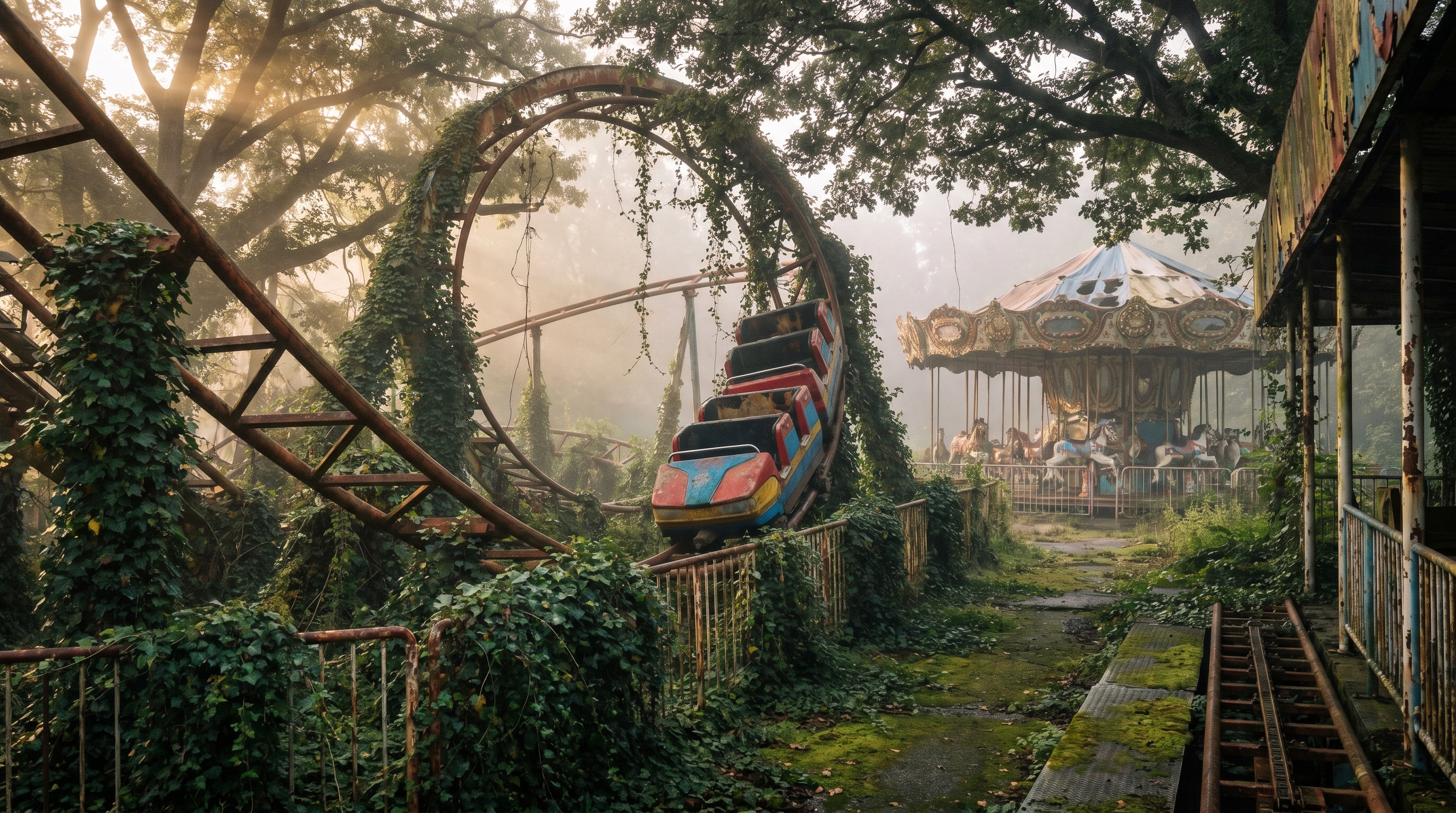
Dark Tourism: When the Fun will rot
There's something fascinating about where joy died. It may be the contrast: a theme park was designed to be the happiest place in the world - living colors, full-volume music, children's laughter - and now that same space is covered with weeds, oxide and silence. The abandoned theme parks are the ghosts of the entertainment industry: dream monuments that were twisted, natural disasters that no one anticipated and business decisions that ended in catastrophe.
This article is not a guide to visiting them - although some can - but a tour of ten of the world's most famous abandoned theme parks. Each has a different history: hurricanes, nuclear mergers, fatal accidents, extreme bad luck. But they all share something: nature claimed what humans built, and the result is as beautiful as it is disturbing.
If you ever wanted to know what happens when a theme park closes and no one ever takes care of it again, keep reading. This is gonna give you nightmares.
Amazon: FlashlightA front flashlight leaves your hands free for photos and balance.
1. Six Flags New Orleans (USA) - The Park Katrina Swallow
The story
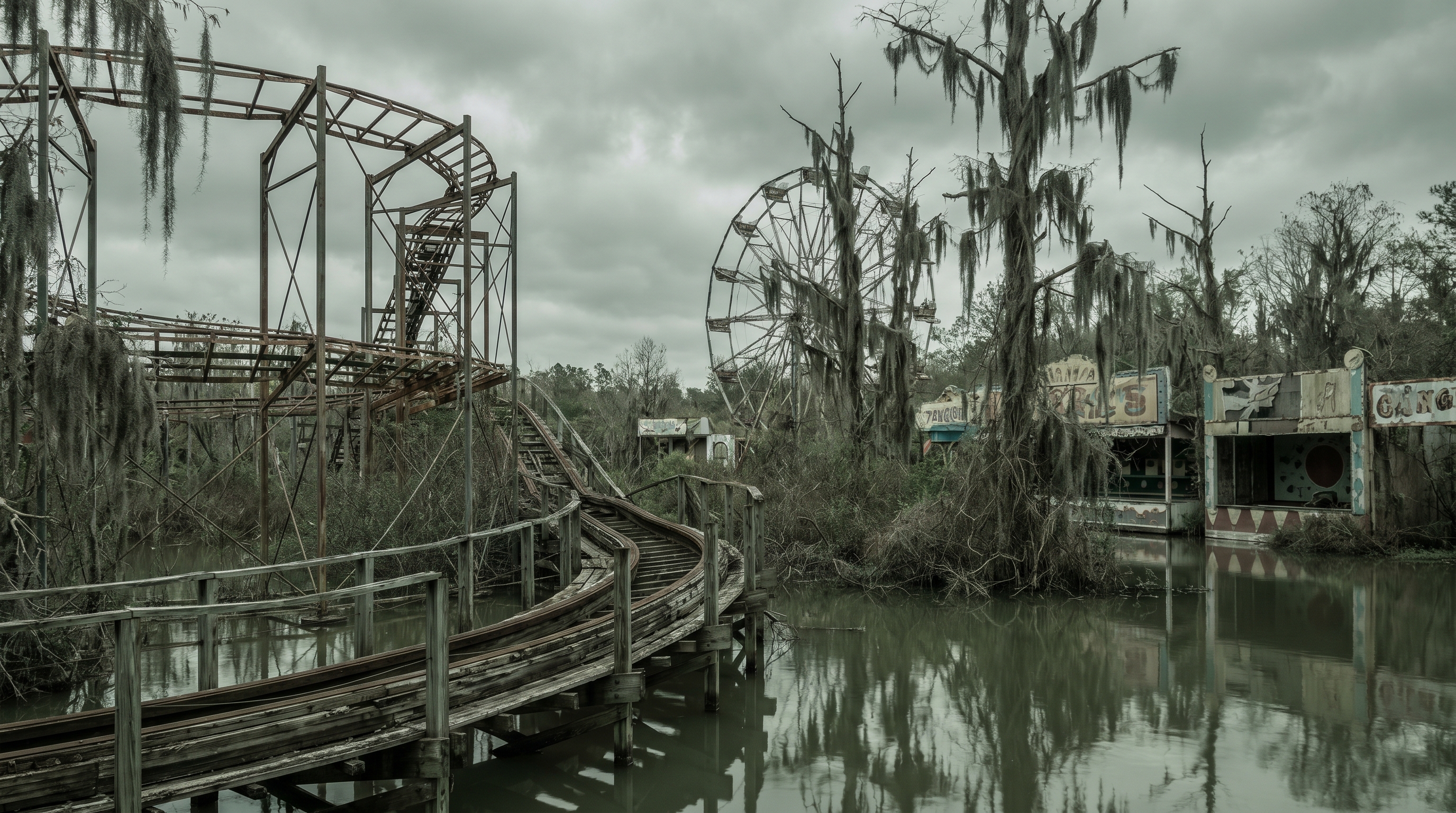
Six Flags New Orleans (originally Jazzland) opened in 2000 in East New Orleans, built on a swamp ground at sea level. The idea was to create a theme park that captured the musical and cultural spirit of Louisiana. I had roll coasters likeMega Zeph(a giant woodie that remembered the classic Coney Island) and water attractions adapted to the humid climate of the south.
The park was never a resounding success. Assistance was mediocre and insufficient income. Six Flags bought it in 2002, changed his name and added some attractions, but the numbers remained unsquare. And then the29 August 2005.
The disaster
Hurricane Katrina broke the New Orleans dykes. The water flooded 80% of the city, and Six Flags New Orleans was submerged underbetween 1.5 and 2 meters of salt waterFor weeks. When the water finally fell, the damage was total: the Russian mountains were corroded, the buildings filled with mold, the electrical systems destroyed. The damage was over 30 million dollars.
Six Flags decided not to rebuild. The city of New Orleans was left with a land full of rusty scrap that no one wanted. Since then, the park has appeared in films likeJurassic World(dondo served as the location of the evacuation) and in dozens of urban exploration documentaries.
What's left today?
The main structures remain: the roller coasterMega ZephIt is a fantastic silhouette against the sky, fast food buildings are covered with graffiti and vegetation, and parking has been absorbed by the high grass. The land belongs to the city, which has proposed reurbanization projects that have never materialized.
Can you visit?Officially, no. It's private property and entering without permission is trespassing. The urban explorers visit him often, but there are sporadic surveillance and fines.
2. Pripyat Amusement Park (Ukraine) - The Park That Never Open
The story
This is probably the most famous abandoned park in the world, and the most tragic. The Pripyat amusement park was scheduled to open the1 May 1986five days after the number 4 reactor at the Chernobyl nuclear power plant exploded on 26 April. He never received official visitors.
The park had three main attractions: a 26-meter-high yellow river, shock cars and a series of children's swings. It was designed for the 50,000 inhabitants of Pripyat, the Soviet model city built for the workers of the nuclear power plant.
The disaster
The Chernobyl explosion contaminated the entire area with radiation. The 50,000 residents of Pripyat were evacuated within hours and never returned. The park, which was to be the recreational jewel of the city, became a symbol of tragedy: the yellow noria rusty under the grey sky has become one of the most iconic images of the 20th century.
There is a chilling detail: during the days between the explosion and the evacuation, the park operators opened it briefly to keep the children entertained while the adults were waiting for instructions. It is possible that some children would turn on the river as the radioactive cloud floated over their heads.
What's left today?
The river is still standing, although in a serious state of deterioration. The shock cars are scattered on the ground, rusty and unrecognizable. The surrounding buildings have discoloured children's walls. The 30 km exclusion area around Chernóbil is accessible with official guided tours from Kiev.
Can you visit?Yes, through official tours authorized by the Ukrainian government. Since 2019, the exclusion zone has been a regulated tourist destination. Radiation levels in the park are relatively low for short visits (equivalent to a transatlantic flight in doses).
3. Nara Dreamland (Japan) - La Copia de Disneyland que No Quiso
The story
In 1961, before Disneyland Tokyo existed, a Japanese businessman named Yunosuke Matsushita visited Anaheim and fell in love with the concept. He traveled to the United States, met Walt Disney and obtained a license to recreate Disneyland in Japan. The result wasNara Dreamland, a park in the city of Nara that was, basically, Disneyland with another name.
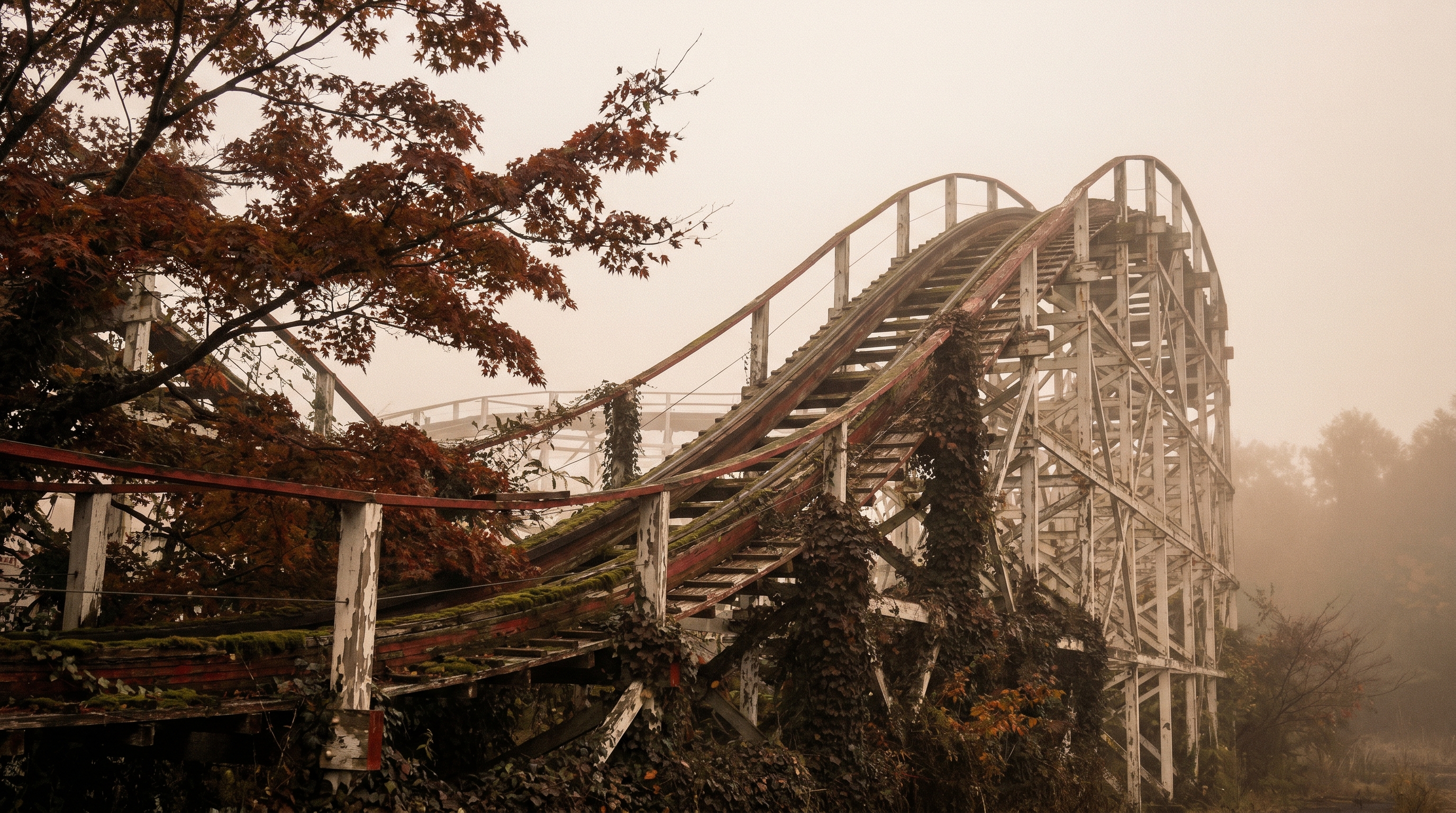
It had its own Sleeping Beauty Castle (smaller), its Main Street (called "Main Entrance"), its own wooden roller coaster (Aska, inspired by Cyclone) and even a monorail. The visitors arrived in mass: in the 1970s and 1980s, Nara Dreamland was Japan's theme park.
The decline
In 1983,Tokyo DisneylandHe opened his doors. Matsushita had lost Disney's license years before, and now she had to compete against the original product. Nara Dreamland tried to modernise, but could never match Disney's investment. The attendance figures fell. From more than 1.6 million visitors per year at their best, it went to less than 200,000.
The park definitely closed atAugust 2006after 45 years of operation. The 140 employees were fired and the attractions were left as they were.
What's left today?
For years, Nara Dreamland was the Holy Grail of Japanese urban exploration. The Russian mountain Aska was still standing, the carousel were intact under layers of dust, and the castle remained upright, though with the painting unconched. The vegetation grew between the tracks of the monorail. In 2016, the land was finally demolished to build a residential complex, but for a decade it was one of the most photogenic abandoned places in the world.
Can you visit?It doesn't exist anymore. It was demolished in 2016-2017. All the pictures are left.
4. Spreepark (Berlin, Germany) - Dinosaurs in the Urban Forest
The story
The Spreepark opened in1969in the district of Plänterwald, in East Berlin, as the only amusement park of the German Democratic Republic (RDA). It was the pride of the socialist regime: an alternative to the western capitalist parks, with a giant noria, a Russian mountain calledEierhuetchen(egg hat), and a collection of dinosaur statues that became their identity sign.
After German reunification in 1990, the park was privatized and bought by the businessman Norbert Witte, who renamed it "Spreepark" and tried to modernise it. For a few years it worked with some popularity, but the competition for larger parks on the outskirts of Berlin was lethal.
The scandal
The Spreepark story gave a surreal turn when Witte was arrested in2002for trying to smuggle 170 kg of cocaine from Peru into the pieces of an attraction called "Flying Carpet." The park closed in 2002 and Witte was sentenced to seven years in prison. His family lived inside the abandoned park for years, in a caravan among the rusty attractions.
What's left today?
The dinosaurs of the Spreepark have become an icon of Berlin: fiberglass statues covered in moss that stand between the trees. The noria is still standing, though with rusty cabins. The land is owned by the state of Berlin, which has developed plans to make it a public space with preserved elements of the original park.
Can you visit?Yes, official guided tours have been organized since 2024. Free access is still prohibited, but organized tours allow you to see dinosaurs, noria and other structures.
Amazon: CameraA compact camera with good low light performance is ideal for dark interiors.
5. Dogpatch USA (Arkansas, USA) - The Hillbilly Park that Sank
The story
Dogpatch USA opened in1968in Marble Falls, Arkansas, based on the comic stripLi'l Abnerfrom Al Capp, who was a parody of American rural life. The park recreated a fictional mountain village with characters from the comic strip, rustic Russian mountains, tyroleas and hillbillies shows. It had an artificial lake and was located in the Ozark mountains, with a spectacular landscape.
In the 1970s, Dogpatch was a compulsory stop for families travelling through Arkansas. It received up to 300,000 visitors a year. But the comic stripLi'l AbnerIt was no longer published in 1977, and it evaporated the brand recognition that supported the park.
The decline
Without the connection to the comic book, the park tried to reinvent itself as a generic mountain attraction, but Silver Dollar City (now Silver Dollar City / DC owned by Herschend) competition in Branson, Missouri, just an hour's drive away, was devastating. The attendance fell below 100,000 a year and the park closed in1993.
Since then, the ground has changed hands several times. There were plans to make it a tourist complex, an artistic community, even a white deer park. None of them materialized at all.
What's left today?
The wood structures are in various states of decomposition. Some buildings collapsed under the weight of the snow, others remain standing. Nature has recruited much of the park: trees grow where once there were queues for attractions. In 2020, the land was acquired by new owners with the intention of preserving part of the story, but the future is uncertain.
Can you visit?Not officially. It's private property with surveillance. Some urban explorers have documented the current state, but doing so without permission is illegal.
6. Okpo Land (South Korea) - Cursed Duck Park
The story
Okpo Land was a small amusement park on Geoje Island, on the South coast of South Korea. It was not a theme park for use: it was rather a modest amusement park with tiovivas, small Russian mountains and a peculiar attraction: aDuck-shaped roller coasterwho was walking a high track on the park's ground.
In order to understand Okpo Land, we must understand South Korea in the 1980s and 1990s: a country in rapid industrialization where job and leisure security was not exactly the number one priority. The Korean amusement parks of the time were notoriously laxity in maintenance.
The accident
In1999, a girl suffered a fatal accident on the duck's roller coaster. The exact details are confusing - sources indicate that the car went off the road in a curve - but the result was the child's death. Instead of investigating and repairing, the owner closed the park and fled, leaving everything as it was.
The most creepy thing: on the roller coaster of the duck, at the exact point where the accident occurred, someone founda children's shoewhich remained there for years, as an involuntary monument.
What's left today?
Okpo Land was partially demolished in 2011, but for more than a decade it was one of the most photographed abandoned places in Asia. The images of the duck's roller coaster - with its rusty wagons hanging from the track - became an icon of the Asian urban exploration.
Can you visit?No. It was demolished and the land has been reurbanized.
7. Gulliver's Kingdom (Japan) - The Park next to the Suicide Forest
The story
In 1997, Yamanashi Prefecture and the Japanese government invested billions of yen in a theme park based onThe Gulliver TravelJonathan Swift. The park was built near Lake Kawaguchi, overlooking Mount Fuji - in theory, a spectacular location. The main attraction was a statue ofLemuel Gulliver, 45 meters longtied to the ground with strings, like at the famous Lilliput scene.
The total cost exceeded 3.5 billion yen (about 25 million euros today). It was a pharaonic project for a park of modest size.
The problem
The park had two fatal problems. First, it was built.in the vicinity of the Aokigahara forest, a dense forest at the foot of Mount Fuji tragically known as one of the most suicidal places in the world. The association was, at least, unfortunate.
Second, the location was difficult to reach by public transport and there were not enough nearby hotels to capture stay tourism. The tourists who visited the area preferred to go to Mount Fuji or the lake, not to a theme park with a giant statue of a man tied to the ground.
The park closed atOctober 2001, only four years after opening. The assistance never exceeded expectations and the losses were enormous.
What's left today?
The Gulliver statue was dismantled, but the foundations and some structures of the park remain visible. The land has been sold and resold without any project taking off. It is a reminder that neither public money nor a good IP guarantee success.
Can you visit?The land is private and access is restricted.
8. Camelot Theme Park (United Kingdom) - The Fall of King Arthur
The story
Camelot opened in1983in Charnock Richard, Lancashire, with a medieval theme based on the legends of King Arthur and the Knights of the Round Table. I had roll coasters likeKnigthmare(a wooden roller coaster that was one of the highest in the UK), medieval fair shows, a lake with special Effects and thematic areas such as "Knight's Valley" and "Squire's Bury."
In the 1990s, Camelot received up to 500,000 visitors a year. It was a family park, with a mainly regional audience in northern England. The medieval theme gave him his own personality in front of more generic competitors.
The decline
Assistance began to fall in the 2000's. The competition of Alton Towers (just 90 minutes by car) and Blackpool Pleasure Beach was too strong. The owners, the Harrison family, invested in new attractions but the numbers did not improve. The 2008 economic crisis was the coup of grace.
Camelot closed at the end of the season2012. The closure was formally attributed to "recession and competition," but employees reported that the lack of investment in recent years had made the park a shadow of what it was.
What's left today?
The land was sold to a real estate developer and there are plans to build houses. The attractions were sold or scrapped. The Knightmare roller coaster was dismantled in 2016. The original Camelot remains very little: some rusty medieval sign and the memories of those who grew up going.
Can you visit?No. The land is in the process of reurbanization.
9. Hard Rock Park / Freestyle Music Park (USA) - Born and died in Two Years
The story
This is the story of one of the most spectacular failures of the theme park industry. InApril 2008Hard Rock Park opened in Myrtle Beach, South Carolina, with an investment of$400 million. It was the first theme park based on rock music: it had thematic attractions of Led Zeppelin (an inverted roller coaster), The Eagle, Moody Blues and Fleetwood Mac, with thematic areas such as "Rock & Roll Heaven," "British Invasion" and "Lost Country."
The investment was huge. The promoters had built a first-level park with capacity for 7,000 daily visitors, amphitheatre for concerts, theme restaurants and a replica of Stonehenge. The expectations were 30,000 visitors a day in high season.
The financial disaster
The reality was devastating. In a park with capacity for thousands, there were often just200-300 persons. The opening coincided with the beginning of the 2008 global financial crisis, the price of petrol was in the clouds, and Myrtle Beach - a seasonal holiday destination - did not have enough tourism outside the summer. This was added to a bad price strategy (the entry cost $50) and an insufficient marketing.
The park closed in September 2008, after only five months of operation. He was bankrupt with over $300 million in debt. In 2009, new investors reopened it asFreestyle Music Park, without Hard Rock's license but with a similar concept. It lasted one more season. In 2010, it was definitely closed.
What's left today?
The land was abandoned for years. The attractions were sold to other parks (Led Zeppelin's roller coaster ended up in Walygator Parc in France). In 2021, the land was acquired by the local school district to build an educational centre. Of the $400 million invested, there is virtually nothing left.
Can you visit?No. The land has been reurbanized.
10. Joyland (Wichita, USA) - The Slow Death of an American Classic
The story
Joyland opened in1949in Wichita, Kansas, and was the largest amusement park in Kansas for over 50 years. I had a classic-wood roller coaster calledRoller Coaster(original name, no phrases), a Wurlitzer Style 160 fair organillo, a tyolive with hand-carved horses and star attraction:Louie the Clown, a real-size mechanical clown who played the cornet and moved on his post.
Joyland was the par excellence amusement park in the American middle of the west: without large investments or elaborate theming, but with genuine charm and family tradition. Three generations of Wichita families grew up going to Joyland.
The decline
The attendance began to fall in the 1990s, the largest park competition in Kansas City and Oklahoma City. The owners, the Ottoway family (which built the original park), sold it in 1997. The new owners did not invest enough in maintenance, and the attractions began to fail regularly.
The park closed after the season2004, reopened briefly in 2006 under another direction, and closed definitely. What followed was a decade of slow decomposition: the Wurlitzer organillo was stolen (appeared years later in an auction), Louie the Clown disappeared (was found in a shed in 2015), and the wooden roller coaster rotted to beam.
What's left today?
The land was finally demolished in 2015- 2018. The roller coaster was dismantled and the materials sold as scrap. The organ was restored and is in a museum. From Joyland there remains the memory and a historical wake in the place where he was.
Can you visit?No. The land has been reurbanized.
Amazon: MochilaChoose a water-resistant with compartments for photographic equipment.
Why are the Thematic Parks closing down? Common patterns
After going through these ten parks, clear patterns emerge. Thematic parks do not close for a single reason - they are often the victims of a combination of factors:
- Unfair competition:Nara Dreamland couldn't fight Tokyo Disneyland. Camelot couldn't fight Alton Towers. When a larger and better funded park opens nearby, the small park is usually crushed.
- Natural disasters:Six Flags New Orleans is the perfect example. A single catastrophic event can destroy decades of investment in hours.
- Location:Gulliver's Kingdom and Hard Rock Park shared the same mistake: building in places without enough tourist demand. People don't travel to a secondary destination just for a theme park.
- Lack of continuous investment:Joyland and Dogpatch died because their owners stopped investing. A theme park that is not renewed is a dying park.
- Management problems:Spreepark is the extreme case (cocaine smuggling), but financial and operational mismanagement is a more common cause of death than it seems.
- Tragedy:Okpo Land was closed by a fatal accident. Pripyat closed for a nuclear catastrophe. Sometimes the closure has nothing to do with business.
The lesson for industry: a theme park is not "build and already." It is a living organism that needs constant feeding (investment, marketing, renewal) to not die.
Urban Exploration: Security Tips
If the idea of exploring an abandoned park attracts you, there are things you must know before you get into one:
- It is illegal to enter without permission in most cases.The abandoned land remains private property. The search fines can be high.
- The abandoned buildings are dangerous.Soil that sinks, structures that collapse, broken crystals, rusty nails, asbestos in ancient materials. The risk of tetanus is real.
- Pollution is an invisible danger.Chemical substances, toxic mold, water stalled with bacteria. In places like Pripyat, radiation is an additional factor.
- Never go alone.If you get hurt in an abandoned place, it can be hours or days before someone finds you.
- Respect the place.Don't break up, don't steal, don't make graffiti. The responsible urbex is "taking pictures, leaving only prints."
- Look for official tours.Places like Chernobyl and the Spreepark offer guided tours that are safe and legal. It's the best way to experience these safe spaces.
Can you visit any Abandoned Park?
Of the ten parks in this article, only a few continue to exist physically and are somehow accessible:
- Pripyat (Ukraine):The most accessible by official tours from Kiev. Several agencies offer one-day excursions.
- Spreepark (Berlin):Guided tours organized by the city authorities.
- Six Flags New Orleans (USA):There are no official tours, but the urban explorers visit it often. It is illegal and carries a risk of fines.
- Dogpatch USA (Arkansas):Private property without legal public access.
The others have been demolished, reurbanized or inaccessible. The window to see these places is ephemeral: once a land has real estate value, the park disappears.
Frequently Asked Questions
The Pripyat amusement park in the exclusion zone of Chernóbil (Ukraine). Its yellow noria has become one of the most recognizable visual symbols of the 1986 nuclear disaster. It is probably the most reproduced image of an abandoned park around the world.
Not in most countries. The abandoned land is private property and entering without authorization constitutes home invasion or invasion of property. The consequences range from fines to detention, according to the jurisdiction. The best thing is to find official tours or the owner's permissions.
Six Flags New Orleans closed because Hurricane Katrina (August 2005) flooded the park under 1.5-2 meters of salt water for weeks. The damage was so extensive (over $30 million) that Six Flags decided not to rebuild. The land belongs to the city of New Orleans and has been abandoned since.
Yes, through official tours authorized by the Ukrainian government. There are several agencies in Kiev that organize day or half-day excursions to the exclusion zone, including the Pripyat amusement park. Radiation levels on tourist routes are low and safe for short visits.
Hard Rock Park in Myrtle Beach, South Carolina. It cost $400 million to build it and closed after just five months of operation in 2008. It was renamed Freestyle Music Park in 2009 and closed again in 2010. It is considered one of the biggest financial failures in the history of theme parks.
The essential: powerful front flashlight with spare batteries, hard shoes with thick sole (working boots), resistant gloves, FFP2 / FFP3 mask (for dust and mold), basic kit, full battery phone, and always be accompanied. It is also recommended to wear a reflective vest if the area has nearby traffic.


